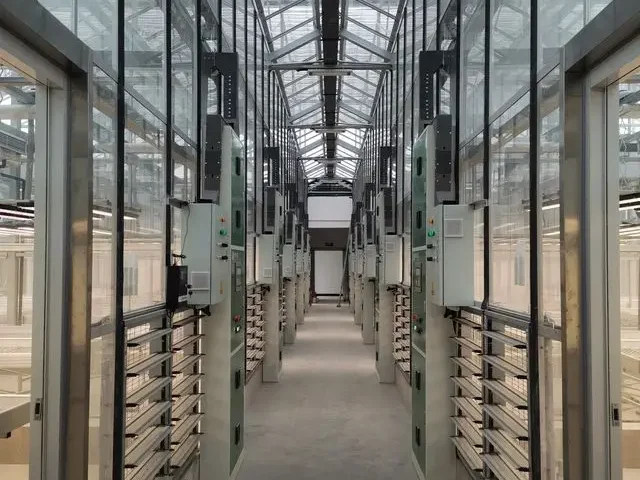
Multi-Climate Zone Smart Glass Greenhouse at XX University’s State Key Laboratory
–Independent climate control units precisely meet the needs of plant science research
I.Project Background: The Demanding Challenges of a Leading Research Institution
The Institute of Plant Sciences at XX University, a State Key Laboratory, conducts research on the virology and physiology of major crops such as rice, wheat, soybeans, and tobacco. To support high-level scientific research, the institute has set extremely high standards for its greenhouse facilities:
| Core Requirements | Technical Challenges |
| 14 completely independent climate zones | Simultaneously conduct comparative experiments with different environmental parameters without interference |
| High-precision environmental control | Meet the daily light integral (DLI) requirement of 24 mol/m²/day for rice and wheat |
| Stable, high-transmittance glass structure | Ensure consistent light transmission and durability for long-term experiments |
| 7-month delivery timeline | Multi-system integration project must be completed on schedule from contract signing to acceptance |
II. Solution: A-Frame Research Greenhouse
2.1 Structural Parameters
| Parameter | Specification |
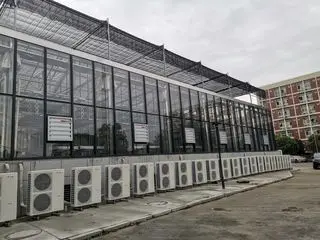
| Building Area | 448 m² (28 m×16 m) |
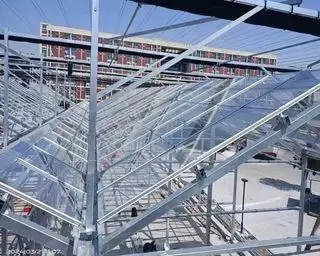
| Structure Type | 7m span A-Frame light steel structure |
| Eave Height | 4.5 m |
| Ridge Height | 6.25 m |
| External Shading Height | 6.9 m |
| Wind Load Capacity | 0.50 kN/m² |
| Snow Load Capacity | 0.30 kN/m² |
2.2 Main Material Specifications
- Columns: 100×100×3 mm hot-dip galvanized rectangular steel tubes (Q235B)
- Roof purlins: 120×60×3 mm hot-dip galvanized square tubing
- Wall purlins: 100×50×3 mm hot-dip galvanized square tubing
- Cross beams: 100×50×3 mm hot-dip galvanized rectangular steel tubing
- Galvanizing Standard: GB/T13912-2020, zinc coating thickness 60–100 μm
- Connection Method: Galvanized bolts + self-tapping screws; no welds; aesthetically pleasing, corrosion-resistant, and easy to install
2.3 Glass Roofing System
| Location | Glass Specification | Performance Features |
| Roof Covering | 5mm Single-Layer Ultra-Clear Tempered Glass | Light transmittance 90%+, excellent support for photosynthesis |
| Exterior Walls | 6+9A+6mm Ultra-Clear Double-Glazed Insulating Glass | Thermal insulation, reduces air conditioning energy consumption |
| Interior Partitions | 5mm Single-Layer Ultra-Clear Tempered Glass | Visual isolation for 14 independent experimental zones |
| Frame System | 6063-T5 Aluminum Alloy Profile | EPDM sealing gasket, excellent air tightness |
III. Independent Climate Control System for 14 Zones
Each 28-square-meter climate zone is equipped with a complete independent control system:
3.1 Ventilation and Cooling System
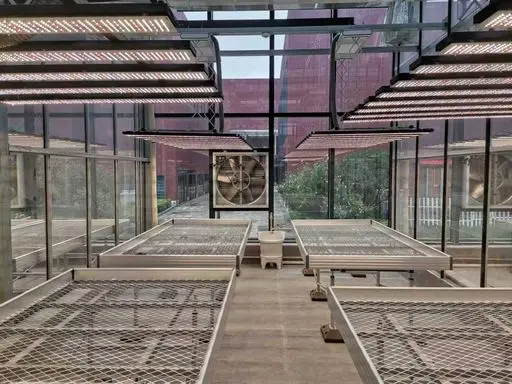
- Variable-frequency negative-pressure fans: Airflow 0–27,500 m³/h, power 0.5 kW per unit
- Intelligent speed control: Automatically adjusts fan speed based on indoor temperature
- Air Exchange Efficiency: Air exchange rate of 1.5 times per minute or higher
- Electric Louvers: 1.0-meter-high side-opening windows are installed on corridor partition walls
3.2 Precise Temperature Control
| Season | Control Target | Method |
| Summer | < 35°C | Fan ventilation + automatic switching to air conditioning cooling |
| Winter | Day: 25°C, Night: ≥ 16°C | Air conditioning heating + internal thermal screen energy saving |
| Transitional Seasons | Natural ventilation as primary | Side windows + fan coordinated control |
3.3 Research-Grade Supplemental Lighting System
- Light Source: Full-spectrum LED plant grow lights
- Suspension Height: 4 meters (electrically adjustable to meet the needs of different growth stages)
- Design Basis: Daily cumulative light exposure of 24 mol/m² for rice and wheat
- Layout Options: Supports both seedling tray cultivation and ground-level cultivation
3.4 Shading and Insulation System
| System Type | Quantity | Features |
| External Shading System | 2 sets (north-south zone separation) | Shading rate 70-90%, energy saving rate 22% |
| Internal Thermal Screen | 14 sets (independent per zone) | Rope and tube drive, separate motor control |
| Side Shading | Reserved interface | Expandable based on future needs |
IV. Intelligent Control System: Enabling Greater Focus on Research
4.1 System Architecture
Central Host Computer (Master Control)
└── 14 Zone Microcomputer Controllers
├── Temperature Sensors
├── Humidity Sensors
├── Light Sensors
└── Equipment Actuator Modules (Fans/Shading/AC/Supplemental Lighting)
4.2 Core Features
• Operates in dual modes: Fully automatic control with manual intervention, flexibly adapting to experimental needs
• Real-time monitoring keeps you informed: Indoor and outdoor temperature and humidity, wind speed and direction, light radiation, rain and snow signals
• Historical data is fully traceable: Automatically stored with export and analysis capabilities to meet scientific data traceability requirements
• Anomaly alerts provide peace of mind: Automatic warnings for equipment failures or parameter deviations
• Coordinated Control: Intelligent integration of window opening, shading, fans, and HVAC systems for energy efficiency
V.Project Execution: Delivering Satisfactory Results in 7 Months
| Date | Milestone |
| December 29, 2023 | Contract signed, project initiated |
| January 17, 2024 | All materials and equipment delivered to site |
| January 28, 2024 | Main steel structure installation completed |
| March – June, 2024 | Glass covering + equipment installation |
| June 28, 2024 | Electrical equipment commissioning completed |
| July 10, 2024 | Main structure and all equipment fully completed |
| August – September, 2024 | Performance testing and final acceptance |
Safety Record: 7-month construction period with zero safety incidents
VI.Acceptance Testing: Let the Data Speak for Itself
Temperature Control Accuracy Test
- Test Conditions: Equipment set to 25°C, continuous monitoring
- Test Results: Indoor temperature remained stable within ±1°C of the set value
- Verification Date: Multiple retests conducted on August 13 and August 15, 2024; data was consistent
System Operating Status
- 14 climate zones operate independently and normally, without interfering with one another
- Temperature, humidity, and lighting parameters for each zone can be independently set and adjusted
- The central control system maintains complete and traceable data records
- All equipment brands, models, and quantities are fully consistent with the contract
VII. Summary of Project Highlights
| Key Metric | Achieved Result |
| Space Efficiency | 448 m² accommodating 14 independent experimental zones, with corridor occupying only 56 m² |
| Control Precision | 14 zones completely independent, temperature control accuracy of ±1°C |
| Energy Efficiency | External shading 22% energy saving + internal thermal screen for nighttime insulation |
| Research Support | Meets precise light and temperature requirements for crops such as rice, wheat, soybean, and tobacco |
| Delivery Speed | Complex multi-system integration project completed in 7 months |
VIII. Customer Testimonials
“The complete independence of the 14 climate zones is exactly what we needed for our comparative experiments. The glass provides consistent light transmission, and the control system is intuitive to operate, which has greatly supported our virology research. From project initiation to delivery, the entire process was professional and efficient.”
— Project Team, Institute of Plant Virology, XX University
IX. More Research Greenhouse Case Studies
If you are planning a multi-climate zone research greenhouse, this project demonstrates our ability to deliver:
- Complex Zone Control: Integrated management of light, temperature, humidity, and air—not just temperature
- Academic-Grade Precision: Meets the stringent standards of National Key Laboratories
- Expertise in Glass Greenhouses: Structural sealing, thermal performance, and durability fully compliant with standards
- On-Time Delivery: Completed on schedule even with 14 independent systems